The plan says one thing.
The site does another.
Nobody can prove what happened.

AROBOTIX is the neutral coordination and verification layer between the digital plan and the job site. It reads the model, confirms what is ready, sequences the work across crews and machines, and creates a defensible record of what actually got built. As AI copilots, sensors, and robots arrive on site, their output becomes evidence in that record, and the record only matters more.

BIMDfMARoboticsAI-AssistConstruction Governance
scroll↓
The Problem

The world spends $16 trillion a year building things. The execution still runs on phone calls.

Most projects go over budget and behind schedule, not because the plans were wrong, but because no one can reliably coordinate and verify what happens on site.

The plans exist

Architects and engineers model every building in detail before a single hole is dug.

The people exist

Skilled crews and contractors are ready, experienced, and accountable for the work.

The robots are arriving

Automation is showing up on job sites worldwide, and the trend only accelerates.

Between the perfect plan and the real site, there is a gap.

No one decides which machine does what, when, and in what order alongside the others. There is no trusted record that the work actually happened. When errors and disputes occur, there is no reliable trail to follow. That gap costs the industry hundreds of billions of dollars a year.

Robots are the unpredictable physical element that needs coordination, sequencing, and verification.
Why Now

Three forces are colliding. For the first time, the coordination layer is both possible and necessary.

01

Robots are on site now

Construction robotics is on track to grow from $1.4B to $3.66B by 2030, a 17.1% annual rate. But robots without coordination are expensive islands. They need a layer that can read the plan and connect them.

02

Digital plans hit critical mass

Major projects now run on detailed BIM models before construction starts. Advances in AI and machine learning make those models readable, analyzable, and decomposable into work.

03

Projects keep getting more complex

The industry is expanding in volume, speed, and scale. More complexity demands faster completion, higher quality, and better safety, which manual coordination cannot keep up with.

What It Does

One layer. Between the plan and the site. Coordinating everything.

Input
Digital Plan (BIM)
↓
Coordination Layer
AROBOTIX
Coordination & Verification
↓
Execution Output
The Job Site
↓
Humans
Robots
Systems

Think of it as the instrument panel for construction execution.

Instruments never tell a pilot what to do. They report what is true: what is ready, what comes next, where everything else is, and whether the world still matches the plan. The recorder keeps every movement on file. The pilot decides and stays accountable. AROBOTIX does the same for sites that mix people, machines, and autonomous systems. Instrument panel, not control tower.

01

Reads the plan

Ingests the digital construction model and converts it into clear, actionable tasks.

02

Coordinates the work

Sequences tasks for the right human or machine, in the right order, with full context.

03

Verifies execution

Creates a real-time, defensible record of what was done, by whom, and when.

04

Works with everything

Robot-agnostic and vendor-neutral. It connects hardware and platforms, it does not replace them.

How It Works

Read the plan → break it down → coordinate → verify → get smarter.

01

Read the plan

Ingests the digital construction model, the complete blueprint for the building.

02

Break into tasks

Converts the complex model into specific, sequenced actions for humans or machines.

03

Coordinate readiness

Before anything starts, confirms the right people, materials, and machines are in place.

04

Execute

People and machines do the work. AROBOTIX provides real-time context and sequencing.

05

Confirm & record

Every completed task generates a verified, time-stamped sequence-validated execution record.

06

Learn

Insights from each project feed the next, improving coordination accuracy over time.

Human review and final accountability stay with the contractor at every step. AROBOTIX supports judgment, it does not replace it.

The Technology

The platforms we are building, in the order they have to be built.

AROBOTIX is an AI-native system with engineered guardrails. The wedge is a compiler that turns models into structured, verifiable work. Everything else is built on top of it.

Foundational wedge Compiler before UI

BIM-to-Executable Task Compiler

The first critical system. It reads the digital model and compiles it into structured execution tasks, with readiness validation, sequencing, and dependency mapping built in. It turns drawings into instructions without dictating means and methods.

In the Crawl phase, classification is rule-based, which is sufficient and more defensible for the pilot than a black-box model. The output is clear, verifiable, trackable tasks.

  • Readiness validation logic and dependency mapping
  • Sequencing options, not sequencing commands
  • Revit support via Autodesk Platform Services, open BIM via IFC
# BIM model → structured executable tasks
task = compiler.compile(model="tower_L12.ifc")

{
  "task_id": "STR-V-0421",
  "group": "STRUCTURE-VERTICAL",
  "readiness": ["rebar_set", "formwork_ok"],
  "depends_on": ["FND-0188"],
  "assignable_to": ["human", "machine"],
  "verify": "sequence_validated_record"
}
Architecture Locked first

Construction Task Object Model (CTOM)

The schema that everything else depends on. CTOM is organized by execution pattern, not trade name, so the same logic generalizes across projects. Each group carries its own readiness prerequisites, verification requirements, and dependency structure.

Getting this schema right is the difference between a system that compounds and one that breaks on the second project.

10 execution-pattern field groups
01Site-Civil
02Foundations
03Structure-Vertical
04Structure-Horizontal
05Envelope
06MEP-Rough
07Interiors-Construction
08Finishes
09MEP-Finish
10Specialty-Systems
Hero output Pilot deliverable

Sequence-Validated Execution Record (SVER)

A confidence-tagged record showing that a task was executed under validated readiness conditions, in its correct position within the model-derived dependency chain, with an attached evidence trail.

It captures the time, the machines, the conditions, and the human confirmation, all traceable. It is a defensive record and a dispute-reduction layer. This is proof of work in the plain sense of the phrase: evidence the work happened the way the plan said it should.

It is not automated QA signoff, legal certification, or fault assignment. Human review and final accountability stay central. When a question comes up months later, the verified record surfaces in seconds, before it becomes a claim.

  • Confidence-tagged, time-stamped, traceable
  • Built around contractor authority, not against it
  • Turns disputes into lookups
Record · concrete pour confirmed
taskSTR-H-0912 · slab pour L12
timestamp2026-08-04 10:03 ICT
assetspump-02, vibrator-04
conditions31°C · slump verified
confirmed_bysite supervisor
confidenceHIGH · 0.94
The moat Compounding

Execution Data Graph

Every project we run produces a dataset no competitor can replicate: the first verified, confidence-tagged record of how construction actually happens at task level. It grows with every build and gets harder to replicate with every cycle.

Features can be copied. Operational intelligence compounds. The graph powers benchmarking, risk prediction, and the pattern recognition that makes the next project's coordination smarter.

Better coordination ↓ Cleaner execution data ↓ Smarter coordination ↓ Stronger network effects
Neutral infrastructure Robot-agnostic

Orchestration & AI-Assist

A neutral intelligence layer that delivers contextual insight across different robots and applications. It captures real-time execution data, sequences work to site conditions, and answers project questions by citing the underlying project data.

AI assists task decomposition with human validation checkpoints throughout. Every robot vendor owns its silo. No one orchestrates across all of them. That neutral position is the strategic advantage, and taking sides with any OEM would destroy it.

  • Robot-agnostic APIs and partner integrations, no hardware lock-in
  • AI-assisted decomposition with human checkpoints
  • Answers cite project data, not guesses
Stack
apiFastAPI
dataPostgreSQL
cloudAWS
bim_revitAutodesk Platform Services
bim_openIFC schema
classifyUniclass · OmniClass
Hardware on the Roadmap

Software first. Hardware where it compounds.

Planned field devices that extend the platform from the screen to the slab. Each one feeds the same execution data graph, and none is required for the software to work. We lean toward integrating proven hardware rather than building from scratch. These are exploratory roadmap items, not shipping products.

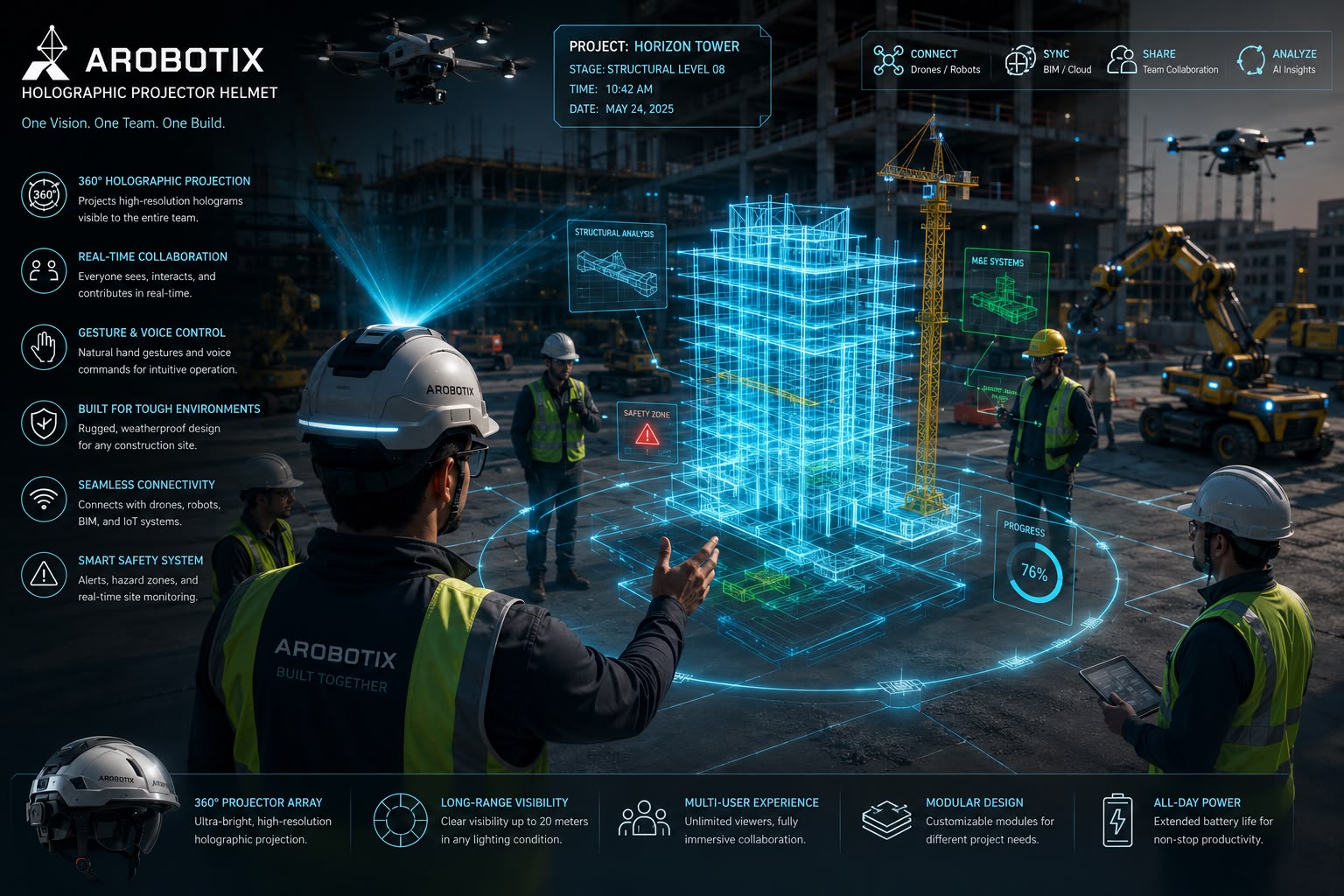
Field UI Viability: High

AR Readiness & Model-Viewing Headset

A heads-up display that overlays the compiler's task sequence, readiness status, and model geometry onto the physical work area. Most likely an integration play on existing AR hardware rather than a ground-up build, which keeps it doable.

It is the field-facing window into the software: the place where the plan meets the slab.

  • Overlays task sequence and readiness on-site
  • Integration-first, not a ground-up build
  • The crew's view into the compiler
AROBOTIX Holographic Projector Helmet concept
Concept render · tap to enlarge
Produces the hero output Viability: High

Helmet-Mounted Execution Capture Cam

A small camera that auto-logs geotagged, timestamped capture against the active task and writes directly to the sequence-validated execution record. It turns "work happened" into a confidence-tagged record without anyone stopping to document.

Strategically the strongest of the five, because it directly produces our hero output.
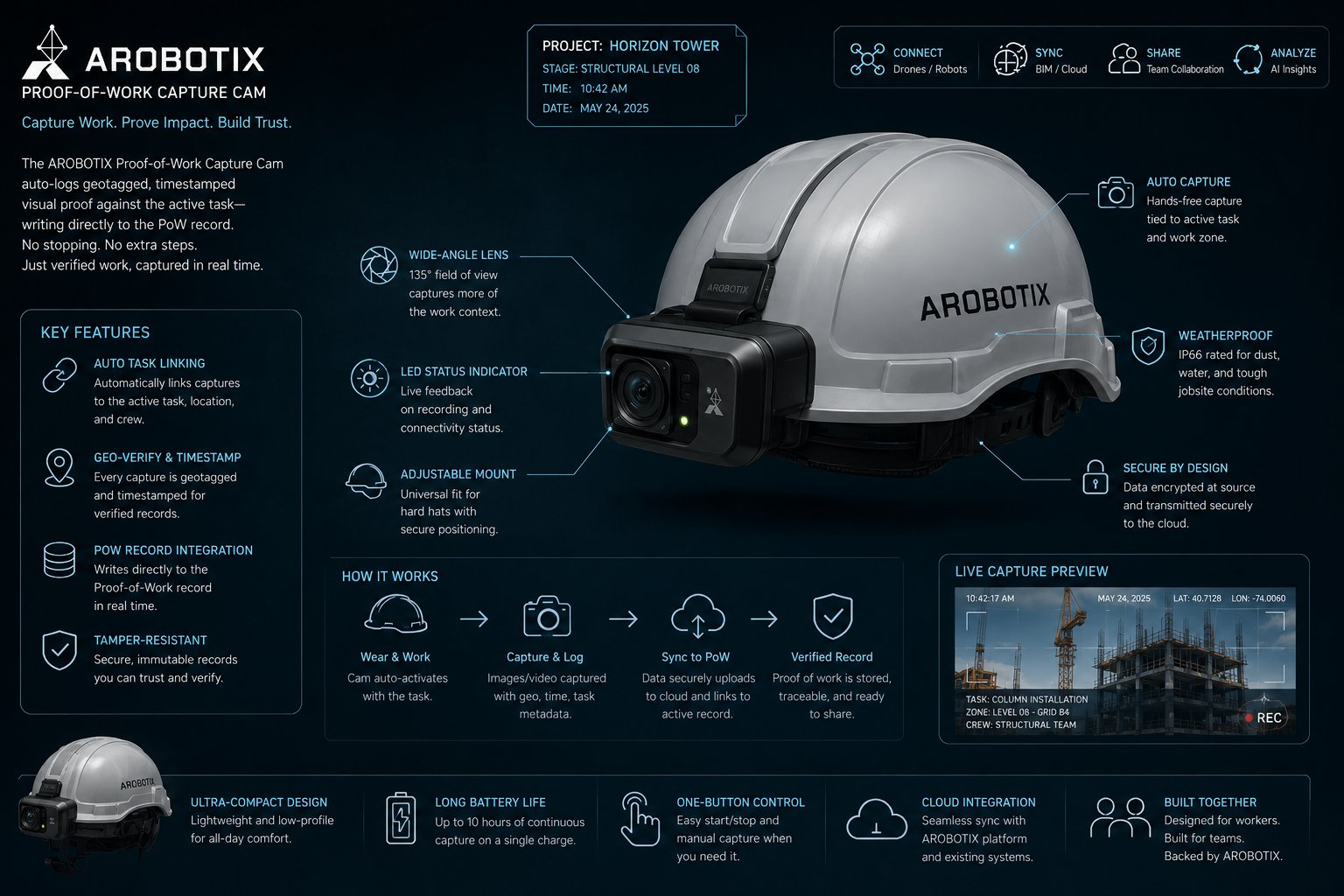
AROBOTIX Execution Capture Cam concept
Concept render · tap to enlarge
Verified readiness Viability: Medium

Readiness Sensor Beacons

Low-cost sensors for the physical prerequisites the CTOM already tracks: concrete maturity, moisture, temperature, and cure state. They turn readiness validation from a human checkbox into a verified signal.

A tight fit with the FOUNDATIONS and STRUCTURE field groups. Harder to build, but defensible because the data is ours.
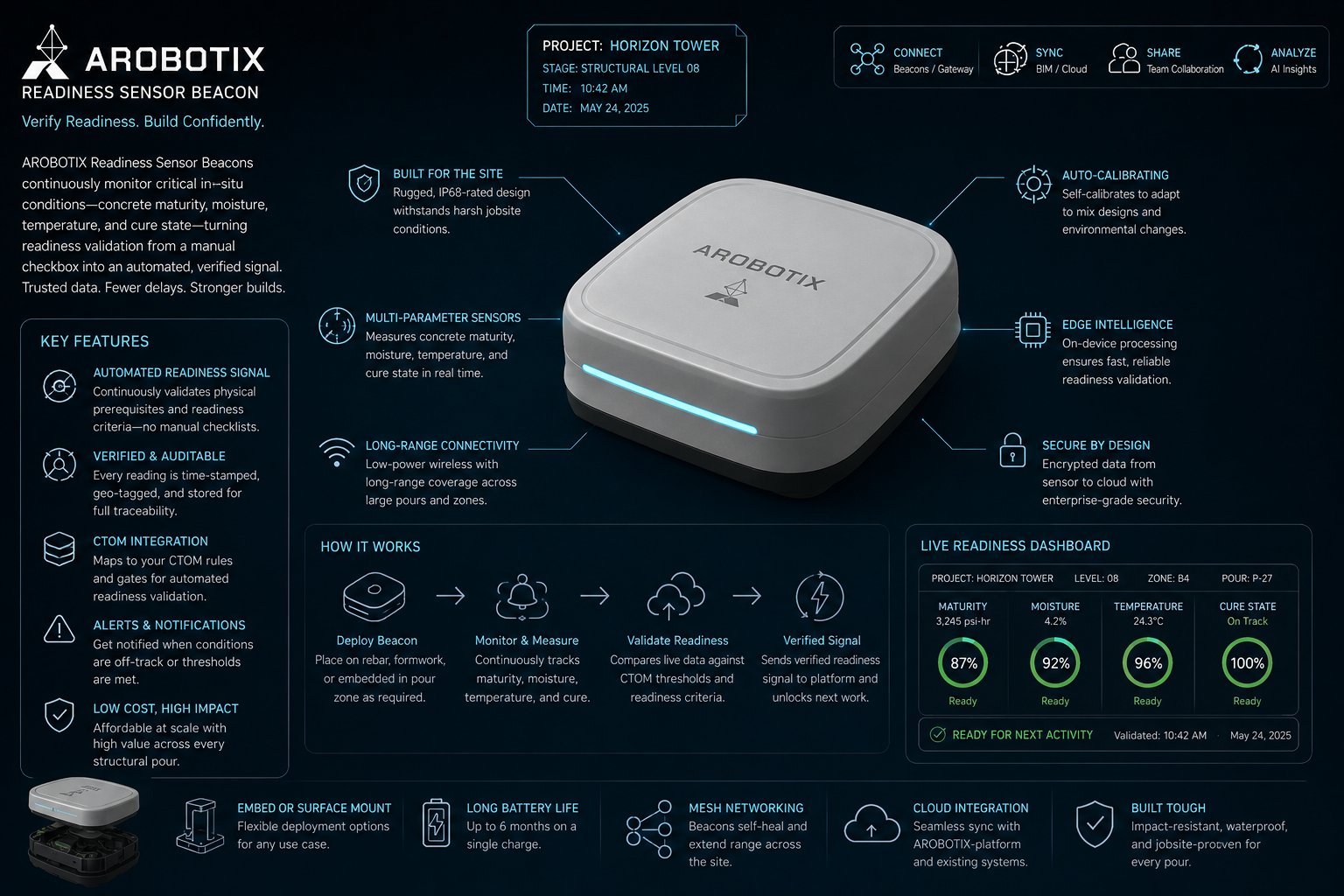
AROBOTIX Readiness Sensor Beacon concept
Concept render · tap to enlarge
Clean data input Viability: High

RFID / QR / NFC Task Tagging

Physical tags placed on assemblies or zones, paired with a scanner, so a worker checks a task in and out by scanning. Cheap, proven technology, easy to build, and it anchors the execution record timeline to real locations and people.

Low differentiation on its own, but a clean, reliable data input into the record.
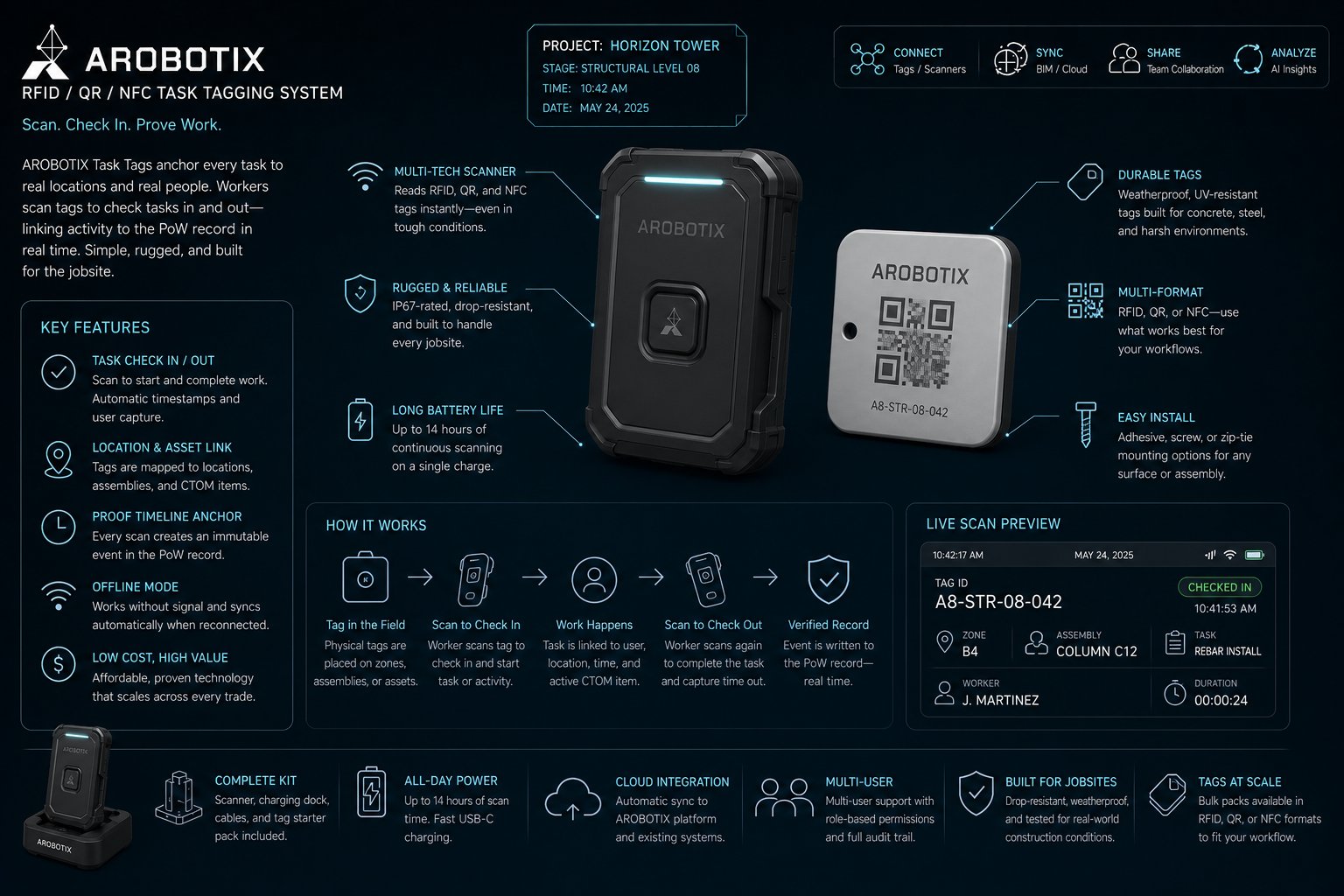
AROBOTIX RFID / QR / NFC task tagging concept
Concept render · tap to enlarge
Future-proofing Viability: Medium

On-Site Edge Gateway

A ruggedized box that aggregates jobsite sensor, camera, and machine data locally, then syncs to the cloud. As sites get more automated and bandwidth gets tight, whoever owns the edge aggregation point owns the data flow.

The least flashy of the five, and arguably the most strategic for the orchestration vision.
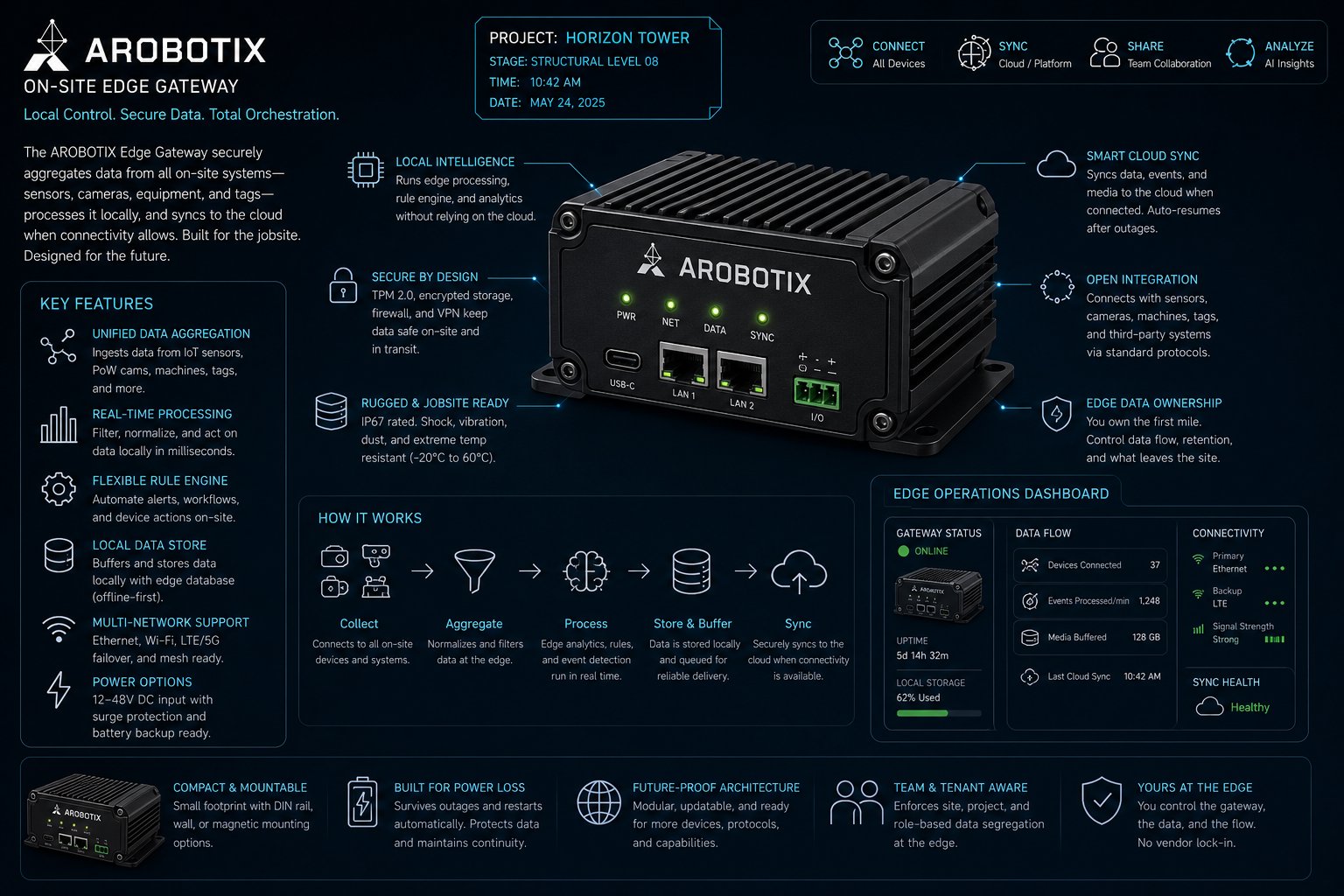
AROBOTIX On-Site Edge Gateway concept
Concept render · tap to enlarge
Why It's Different

Everyone owns a piece. Nobody owns the layer between them.

Design platforms answer what should be built. A new class of worker copilots answers whether one install is correct right now. Neither answers the question a project actually gets sued over: was the site ready, in the right sequence, with a defensible record if this becomes a dispute in eighteen months. Point-in-time versus chain of custody. That is the whole distinction.

Design platformsWorker copilotsAROBOTIX
Question answered What should be built Is this install correct now Was the site ready, in sequence, provably
Scope The model One task, one moment The full dependency chain
Record produced Documentation Inspection result Sequence-validated execution record
Relationship to AROBOTIX Upstream input Evidence input (integration path) The layer between them
Swipe to compare →

Human-first by design

Humans remain the final decision-makers. The reason general contractors will trust this system is the same reason they cannot easily rip it out: it is built around their authority, not against it. That is critical for adoption, liability, and trust.

Neutral, so it compounds

AROBOTIX sits above the tool stack and connects it. Procore manages projects. Autodesk owns design. Trimble captures field data. Robotics vendors build single-task hardware. None of them coordinate execution across all of it. That is the gap.

Neutral to vendor, and to outcome

The layer that records execution cannot be the layer that performs it. AROBOTIX owns no equipment and employs no labor, which is why the record holds up when a project goes to dispute.

AROBOTIX runs on sites with no AI copilots, no glasses, and no robots. Where those exist, their output becomes evidence in the record. Where they do not, the record is unchanged.

Benefits & Outcomes

What changes on your site.

AROBOTIX does not build anything. It makes sure what gets built is coordinated, confirmed, and defensible. Here is what that looks like in practice.

Fewer lost mornings

Readiness across crews, machines, and materials is confirmed before the day starts, so work begins on time instead of after an hour of phone calls.

Disputes become lookups

Every task leaves a confidence-tagged, time-stamped record. When a question comes up months later, the answer surfaces in seconds instead of in a claim.

Every build makes the next smarter

Insights from each project feed the next, improving coordination accuracy and surfacing risk earlier over time.

A day with AROBOTIX

  • 6:55 AM. The foreman opens AROBOTIX. Readiness across crews, machines, and systems is confirmed. The day's sequence is set before the briefing starts.
  • 10:00 AM. A pour completes. The time, machines, conditions, and supervisor confirmation are recorded instantly. A sequence-validated execution record, tagged and defensible.
  • 6 months later. A dispute surfaces. The verified record appears in seconds. It is resolved before it becomes a claim.

What you get

  • Lower coordination overhead and fewer lost mornings
  • A defensible record that reduces dispute and rework exposure
  • No hardware lock-in: it works with the robots and tools you already use
  • Your team keeps authority. The platform supports decisions, it does not make them
  • A coordination advantage that grows as your sites adopt more automation
Partnerships

Build the future of construction with us.

AROBOTIX is neutral infrastructure. It gets more valuable as more of the ecosystem connects to it. We partner across the construction value chain, and every partner makes the coordination layer stronger.

General contractors & builders

Run a structured pilot, shape the roadmap around how you actually build, and gain a coordination and verification advantage as your sites adopt automation.

Robot & equipment vendors

Connect your hardware through robot-agnostic APIs and reach customers through the orchestration layer. No lock-in and no taking sides. Your machines become part of a coordinated site.

Technology & software partners

BIM, scheduling, and field platforms integrate so data flows end to end. AROBOTIX sits above the tool stack and connects it rather than replacing it.

Owners & developers

Get transparent, verified execution records on your assets, lower dispute and rework exposure, and clearer visibility from plan to finished building.

Government & infrastructure

Bring defensible verification to critical public projects where accountability and a trustworthy record matter most.

Academic & standards partners

Collaborate on research, validation, and standards alignment with groups like the BIMForum DfMA Working Group and university research teams.

AI copilot & wearable providers

Their field output attaches to the task record as evidence. Your inspection result stops being a standalone check and becomes part of a sequenced, defensible chain.

Become a partner

Whether you build, manufacture, develop, or research, there is a place for you in the AROBOTIX ecosystem. Tell us how you want to work together.

Become a partner →
Who is building this

Two people, and the reason each one is here.

This is not a team page. It is the founder and the co-founder who are carrying this, and what qualifies them to. If a company is going to claim it can produce a record a project can defend, the people making that claim should be legible.

Founder & CEO

Han Hoang

Ho Chi Minh City. MIT, Design and Computation. 25 years in BIM, DfMA, and VDC.
Full backgroundClose▾
  • Master of Architectural Studies, MIT, Design and Computation Group. Thesis on Automated Construction Technology, 2005
  • More than 25 years across BIM, DfMA, and VDC
  • Founded The BIM Factory, Vietnam's leading BIM services firm, and ran it for 12 years
  • Active on the BIMForum DfMA Working Group in the United States and the Vietnam BIM Steering Committee

Why he is doing this. He wrote his MIT master's thesis on automated construction in 2005, two decades before the market caught up to the question. Every year since has been the same lesson from a different angle. Twelve years running a BIM services firm meant delivering models that were correct on screen, then watching the same coordination failures repeat at the point of assembly. The models were never the problem. Nothing existed to carry their logic into the field and record what actually happened there. This is not a pivot into a hot category. It is the same problem he has been circling for twenty one years, finally buildable.

Co-founder & CTO

Sahil Harriram

Australia-Vietnam. Robotics and embedded systems. Shipped control systems into mining and military EVs.
Full backgroundClose▾
  • Honours degree in Mechatronics, Robotics and Automation Engineering, University of Newcastle
  • Co-founder and CEO of Elite Robotics, an autonomous vehicle platform. Raised pre-seed funding and NSW government grants, and partnered with councils and universities
  • At 3ME Technology, built BladeVolt, a modular lithium-ion battery management system for mining and military electric vehicles, including a 15 ton loader. Cut battery production time from two months to three days
  • Reverse-engineered legacy Volvo loader hardware for electrification, leading to a multi-million dollar contract
  • Built an LLM-assisted decision engine on deterministic logic and audit trails, the same architecture pattern the execution record depends on
  • Embedded C and C++, RTOS, robotics algorithms, MQTT, full-stack. Owns the AROBOTIX platform architecture and built the proof of concept on real IFC data

Why he is doing this. His career has been machines that work in places nobody mapped for them. Autonomous platforms. Mining loaders. Military EVs. Every one of them taught the same lesson, and most robotics founders learn it too late. The hard part was never the machine. It was that the machine had no reliable way to know what was ready, what came next, or whether the world still matched the plan. He then spent years building decision systems where the answer had to survive scrutiny, which means deterministic logic and an audit trail sitting underneath anything the AI produced. Construction is both problems at the same time, with people in the middle of it. Better robots do not solve that. The layer underneath them does.

Why these two

This challenge sits at a unique intersection requiring both deep construction expertise, understanding readiness for concrete pours, trade handovers, and unwritten dependencies, and an engineering background in deploying autonomous platforms, heavy industrial machinery, and auditable decision systems into unpredictable environments. Most solutions come from software developers who lack job-site experience or construction professionals who have never deployed embedded systems. Combining twenty-one years of construction experience with ten years of engineering experience is exactly what this layer demands.

The broader operating team and advisors have been intentionally omitted. This page focuses strictly on foundational build accountability, which rests with just two individuals.

Commercial model

How this gets priced. Not what it costs yet.

AROBOTIX is pre-commercial. The first structured pilot begins in Q4 2026, and no rate card exists because none has been earned yet. Publishing prices before a single site has run them would be guessing in public. What we can share is the shape of the commercial model, so you know what a conversation would look like when the time comes.

Model 01

Pilot engagement

A single site, fixed scope, fixed duration.
  • Scoped to one project, not an open commitment
  • Success criteria agreed in writing before day one
  • Measured on coordination hours saved and readiness failures caught
  • Priced as an engagement, not a subscription
Model 02

Per-site

Project-by-project, once pilots convert.
  • A fee per active site, per month
  • Lowest barrier for a contractor testing a second and third project
  • Scales with sites, not with seats or users
  • No portfolio-wide commitment required
Model 03

Enterprise licensing

Portfolio deployment for contractors and owners.
  • Annual or multi-year platform licensing
  • Support and service levels defined per agreement
  • Portfolio analytics and integration into existing systems
  • Reached through per-site use, not sold ahead of it
Model 04

Partner and OEM

For robot, equipment, sensor, and software vendors.
  • API access for integration, vendor-agnostic by design
  • Usage-based pricing for high-volume verification
  • Revenue-share arrangements where volume justifies it
  • Structured case by case, no standard template yet

Why there is no price on this page

A number published today would be an estimate dressed up as a rate. Scope, site count, model quality, and integration depth move the figure more than any list price could account for. The honest version is that pricing gets set once real sites produce real numbers, and the pilot is what produces them.

What you can do now

If task readiness and execution records are a live problem on your projects, the useful next step is a scoping conversation, not a quote. We are selecting a small number of pilot partners, and the criteria are project fit and willingness to measure results, not budget.

Status as of September 2026. This section will be replaced with published pricing once pilot results support it.

The Future

The next big construction platform won't build.
It will prove what was built.